In recent years, the term “blockchain” has become synonymous with cryptocurrencies, such as Bitcoin and Ethereum. But what exactly is blockchain technology, and how does it power the world of crypto markets? If you're new to the crypto space or simply curious about the underlying technology, this article will give you a comprehensive understanding of blockchain and how it fuels the cryptocurrency ecosystem. What is Blockchain Technology? At its core, blockchain is a distributed ledger technol
In recent years, the term “blockchain” has become synonymous with cryptocurrencies, such as Bitcoin and Ethereum. But what exactly is blockchain technology, and how does it power the world of crypto markets? If you're new to the crypto space or simply curious about the underlying technology, this article will give you a comprehensive understanding of blockchain and how it fuels the cryptocurrency ecosystem.
What is Blockchain Technology?
At its core, blockchain is a distributed ledger technology. It’s a decentralized system for recording transactions across many computers so that the data cannot be altered retroactively. In simpler terms, it’s a digital ledger of transactions that’s duplicated and distributed across a network of computers (also known as nodes), making it incredibly difficult to tamper with or hack. This makes blockchain particularly useful in scenarios where trust, transparency, and security are crucial.
How Does Blockchain Work?
To understand how blockchain works, let’s break it down into its main components:
Blocks:
Each transaction that takes place on the blockchain is stored in a "block." These blocks are like pages in a digital ledger. Each one contains a list of transactions, a timestamp, and a unique identifier called a "hash."
Chain:
Once a block is filled with transactions, it’s linked to the previous block using a cryptographic hash. This forms a chain of blocks, hence the name “blockchain.” Each new block contains the hash of the previous block, making the entire chain interconnected. This structure ensures that data cannot be altered without changing the entire chain, which would require the consensus of the network.
Decentralization:
Traditional centralized databases rely on a single entity (like a bank or government) to control and validate transactions. In contrast, blockchain is decentralized. Multiple participants (nodes) in the network validate and verify transactions. This decentralization ensures that no single party has control over the data, making blockchain more resilient and transparent.
Consensus Mechanisms:
For transactions to be added to the blockchain, the network must agree on the validity of those transactions. This is where consensus mechanisms come into play. The most well-known consensus mechanism is Proof of Work (PoW), used by Bitcoin. PoW requires miners to solve complex mathematical puzzles to validate transactions. Other mechanisms include Proof of Stake (PoS), which relies on validators who lock up a portion of their cryptocurrency as collateral, and , which uses elected representatives to validate transactions.
Understanding Blockchain Technology: How It Powers Crypto Markets | BuddyTrading Blog
Delegated Proof of Stake (DPoS)
Blockchain and Cryptocurrencies: A Perfect Match
Now that we understand how blockchain works, let’s see how it powers cryptocurrencies and crypto markets. Cryptocurrencies like Bitcoin, Ethereum, and thousands of altcoins are built on top of blockchain technology. Here’s how the two work together:
Decentralized Transactions:
Traditional financial systems rely on intermediaries, like banks, to validate and process transactions. With cryptocurrencies, blockchain eliminates the need for intermediaries by enabling peer-to-peer transactions. When you send Bitcoin to someone, the transaction is broadcast to the network, verified by nodes, and recorded on the blockchain. This system is faster, cheaper, and more transparent than traditional banking.
Transparency and Immutability:
Blockchain offers a transparent record of all transactions. Once a transaction is recorded, it cannot be altered or deleted without the consensus of the network. This makes blockchain an ideal system for cryptocurrencies, as it ensures that all transactions are publicly available for anyone to verify. This level of transparency builds trust among users and ensures the integrity of the crypto markets.
Security:
Blockchain technology uses cryptographic algorithms to secure transactions. Every transaction is encrypted, and the decentralized nature of blockchain makes it highly resistant to fraud and hacking. In traditional financial systems, central entities can be hacked, leading to data breaches or loss of funds. However, with blockchain, hacking one block would require altering every subsequent block in the chain, which is nearly impossible without the consensus of the entire network.
Anonymity and Privacy:
While blockchain provides transparency, it also allows users to maintain privacy. In most cryptocurrencies, transactions are pseudonymous, meaning that while transaction details are recorded on the blockchain, the identities of the participants are not directly linked to those transactions. This balance between transparency and privacy is one of the reasons blockchain is appealing to many people in the crypto world.
Blockchain’s Role in Crypto Markets
Blockchain is more than just a technology behind cryptocurrencies; it fundamentally shapes the way crypto markets operate. Let’s explore how blockchain influences the crypto market.
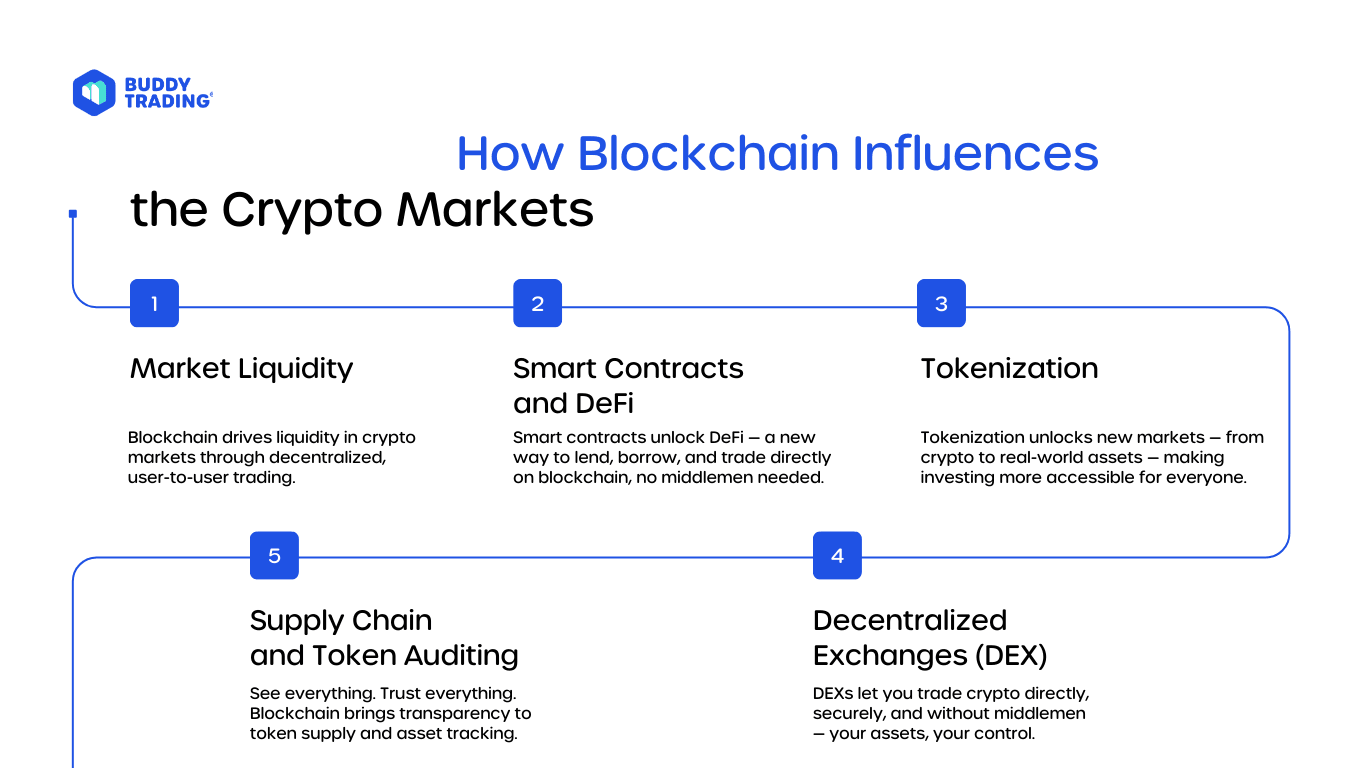
Market Liquidity:
Blockchain plays a significant role in ensuring liquidity in crypto markets. With a decentralized exchange (DEX) model, blockchain enables direct trading between users without relying on intermediaries like centralized exchanges. This promotes more efficient trading and allows for quicker execution of orders.
Smart Contracts and DeFi:
Smart contracts are self-executing contracts with the terms of the agreement directly written into code. These contracts run on blockchains like Ethereum, and they enable decentralized applications (dApps) to operate without the need for centralized authority. This gives rise to the rapidly growing DeFi (Decentralized Finance) sector, which is reshaping how financial services such as lending, borrowing, and trading are conducted. DeFi platforms use blockchain to enable users to engage in financial activities directly with each other, without relying on banks or traditional financial institutions.
Tokenization:
Blockchain allows for the creation of tokens—digital representations of assets—on its ledger. These tokens can represent anything from cryptocurrencies to real-world assets like real estate, art, or commodities. Tokenization has made it easier for investors to trade and invest in a wide range of assets, democratizing access to markets that were previously inaccessible. The rise of Non-Fungible Tokens (NFTs) is a perfect example of how blockchain technology enables the ownership, buying, and selling of digital collectibles and assets.
Decentralized Exchanges (DEX):
While traditional exchanges act as intermediaries between buyers and sellers, decentralized exchanges (DEXs) operate directly on the blockchain, allowing users to trade cryptocurrencies peer-to-peer. DEXs leverage blockchain’s decentralization to ensure that users retain control over their funds at all times. This is a key benefit for traders, as it reduces the risk of hacks or theft that is common in centralized exchanges.
Supply Chain and Token Auditing:
Blockchain’s transparency is incredibly useful for tracking the provenance of assets, including tokens in the crypto market. By leveraging blockchain, users can audit the supply of tokens and ensure that no malicious activities like counterfeiting or double-spending are taking place. This is especially useful for maintaining trust in the market and reducing fraud.
The Challenges of Blockchain in Crypto Markets
While blockchain technology has revolutionized the way crypto markets operate, there are still some challenges that need to be addressed:
Scalability:
As more users participate in the crypto market, blockchain networks can become congested, leading to slow transaction times and high fees. Networks like Bitcoin and Ethereum have faced scalability issues as their popularity has grown. However, solutions like the Lightning Network for Bitcoin and Ethereum 2.0 are being developed to address these concerns.
Energy Consumption:
Blockchain networks, especially those using Proof of Work (PoW) like Bitcoin, are often criticized for their high energy consumption. Mining activities require a large amount of computational power, contributing to a significant carbon footprint. As blockchain technology evolves, more energy-efficient consensus mechanisms like Proof of Stake (PoS) are being adopted to mitigate this issue.
Regulation:
As cryptocurrencies continue to gain popularity, governments and regulatory bodies are working to establish frameworks for their use. Blockchain’s decentralized nature presents challenges for regulators, as it’s harder to impose traditional control mechanisms on decentralized networks. However, regulatory clarity will be crucial for the future growth and stability of the crypto market.
The Future of Blockchain in Crypto Markets
Blockchain technology is continually evolving, and its role in crypto markets will only expand in the coming years. With advancements like Layer 2 solutions, sharding, and interoperability between different blockchain networks, blockchain’s potential to revolutionize finance and beyond remains vast.
Moreover, the development of decentralized autonomous organizations (DAOs) and innovations in tokenization, NFTs, and smart contract functionality will likely reshape industries such as finance, healthcare, supply chain management, and governance.
Conclusion
Blockchain technology is the backbone of the cryptocurrency world. It provides a decentralized, secure, and transparent way to record transactions, making it the perfect foundation for digital currencies and decentralized financial systems. Understanding how blockchain powers the crypto market is essential for anyone looking to enter the space. As blockchain continues to evolve, its applications will expand, creating new opportunities and challenges in the world of finance and beyond. Whether you’re an investor, developer, or enthusiast, blockchain technology is here to stay, and it’s only just getting started.
 Our Blog




 8 min read