In the world of crypto trading, strategies and technical skills are essential - but without the right mindset, even the best traders can fail. Two emotions, fear and greed, dominate most trading decisions. Mastering these can be the difference between consistent profits and repeated losses.
Why Psychology Matters in Crypto Trading
Crypto markets are notoriously volatile. Unlike traditional markets, crypto trades 24/7, with price swings that can exceed 10% in a single day. According to a 2023 study by Binance Research, over 60% of beginner traders exit the market within six months due to emotional trading mistakes most commonly driven by fear and greed.
Understanding Fear in Trading
Fear manifests in different ways:
Fear of missing out (FOMO): Jumping into a rally too late.
Fear of loss: Selling too early to avoid potential losses.
Fear of being wrong: Hesitating to execute a well-researched trade.
These behaviors often lead to buying high and selling low - exactly the opposite of successful strategy.
Understanding Greed in Trading
Greed pushes traders to:
Hold positions too long, expecting infinite gains.
Over-leverage to maximize short-term profits.
Ignore their trading plan in pursuit of more.
Over 70% of traders who over-leveraged in crypto suffered losses larger than 25% of their capital.
How to Overcome Fear and Greed
1. Develop and Stick to a Trading Plan
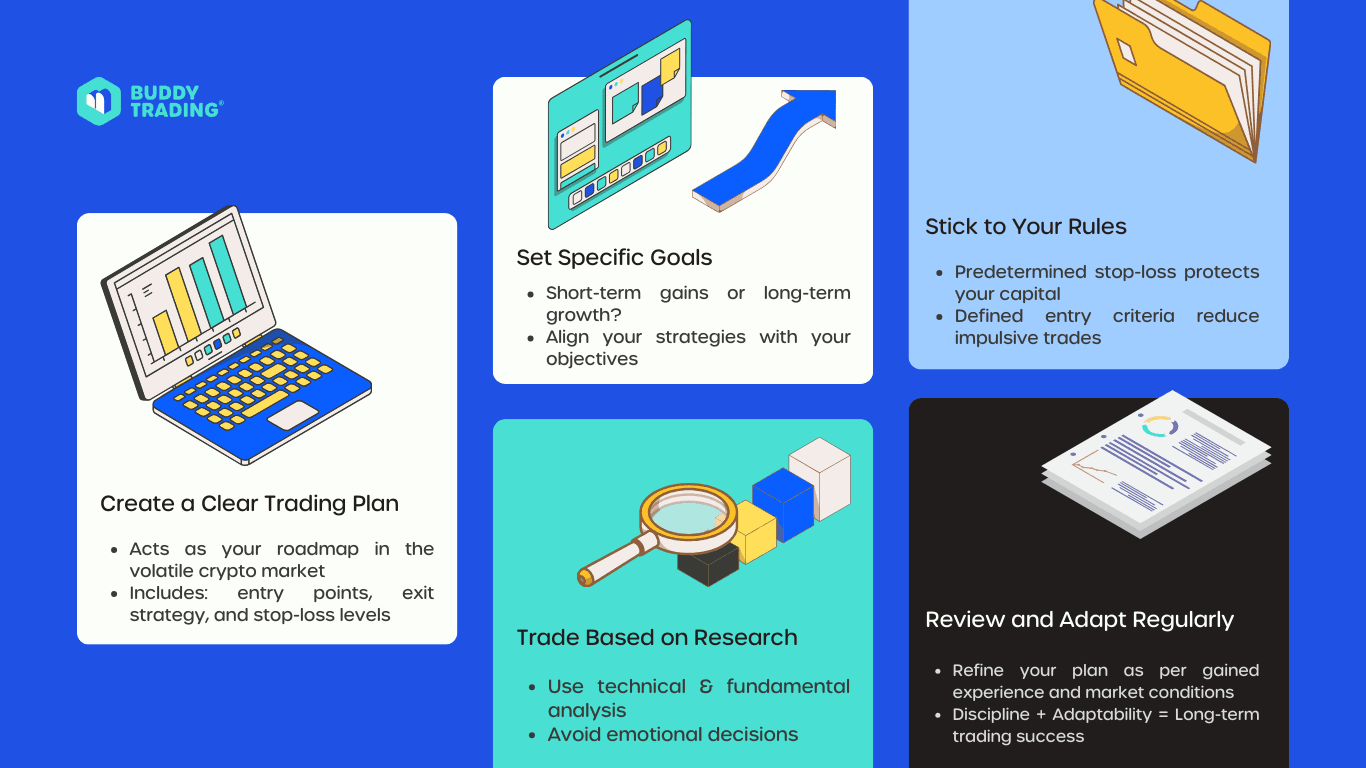
A trading plan is your blueprint for navigating the volatile crypto market. It defines your entry, exit, and stop-loss levels, helping you make decisions based on logic rather than emotion. Start by setting clear goals - whether for short-term trades or long-term growth - and align your strategy accordingly. Research your chosen assets and use both technical and fundamental analysis to guide your decisions.
A solid plan reduces emotional impulses, like chasing rallies or panic-selling during downturns. For example, predetermined stop-loss levels protect your capital, while clear entry criteria prevent impulsive trades. Stick to your rules, even when market conditions tempt you to deviate, as consistency is key to long-term success.
Review your plan regularly, refining it as you gain experience and as market conditions change. Discipline and adaptability are your greatest tools for navigating the challenges of crypto trading.
2. Position sizing and risk management
Following the 1-2% rule means you only risk a small portion of your portfolio on a single trade - usually between 1% and 2% of your total capital. This strategy cushions against emotional breakdowns after a loss and gives your portfolio room to recover.
For example, if you’re trading with $5,000, your maximum risk per trade should be $50 to $100. This prevents one bad decision from wiping out weeks of progress and helps you stay calm even when the market moves against you.
Trading Psychology: Overcoming Fear and Greed in Crypto Trading | BuddyTrading Blog
3. Use stop-losses and take-profits
Setting these levels before entering a trade automates your exits and removes emotional guesswork. A stop-loss ensures you get out when a trade moves too far against you, preserving capital. A take-profit locks in gains when the price hits your target.
For instance, if you're trading BTC and enter at $60,000, you might set a stop-loss at $58,500 and a take-profit at $63,000. This ensures your emotions don't override your logic when volatility spikes.
4. Journal every trade
A trading journal isn’t just a notebook - it’s your personal feedback loop. The most successful traders treat journaling as a performance tool, not an afterthought. For each trade, record your entry and exit points, position sizes, and market context (such as trending news or technical setups). But what truly separates amateurs from pros is logging your emotional state - before, during, and after the trade.
Over time, you'll spot patterns like “I always rush entries after a loss” or “I get greedy during bull runs.” Identifying these tendencies allows you to correct them proactively. Once you see these tendencies in writing, you can address them head-on. This small habit leads to big improvements in discipline.
5. Practice mindfulness and detachment
The brain isn’t wired to perform under constant stress. Watching charts all day elevates cortisol levels, which clouds judgment and increases impulsive behavior. Studies have shown that high cortisol can reduce prefrontal cortex activity - where logical decisions are made - by up to 20%.
To counteract this, take regular breaks throughout the trading day. Step outside, stretch, or do a quick breathing exercise. Many top traders practice mindfulness using apps like Headspace or Calm, which help them develop emotional distance from market noise. Even 10 minutes of meditation daily can improve focus and reduce reactionary decisions.
Mindful detachment isn’t about ignoring the market - it’s about creating space between stimulus (price movement) and response (your action). This is where discipline is born.
6. Learn from copy trading
Emotions run high when you’re trading alone - especially if you’re new. Every entry feels like a gamble, every red candle a threat. This is where copy trading offers more than just convenience - it’s a fast-track to emotional discipline.
Platforms like BuddyTrading allow beginners to mirror the trades of seasoned professionals in real time. But this isn't just about passive profit - it's an educational tool. As you follow how pro traders manage entries, exits, stop-losses, and position sizes, you start internalizing their structured approach.
This method reduces the emotional burden of decision-making. Instead of reacting impulsively to price action, you’re exposed to disciplined, rule-based strategies - which over time, become second nature.
Emotions aren’t the enemy - poor control of them is. Understanding how fear and greed affect your decisions is the first step toward mastering trading psychology. In a market where over $1 trillion in value can be added or wiped in a month, keeping a clear head is your greatest edge.
Want to gain confidence and reduce emotional bias? Start your journey with smarter tools like BuddyTrading - where strategy meets psychology.
Subscribe to our newsletter and be the first to access exclusive content and expert insights.
Education
Crypto Bot Social Selling 101 – A Step-by-Step Guide for Quant Trader
Learn how to promote your crypto trading bot with social selling from a marketing approach. Use GitHub, Discord, X, Reddit, and BuddyTrading to build trust and monetize strategies

 Our Blog
 5 min read

 Dec 18, 2025