Most bot trading platforms own your strategy, not you. Learn how BuddyTrading's P2P marketplace protects creator IP and pays on real performance — not promises.
Table of Contents
What Is "Alpha" — and Why It Matters
How Most Bot Platforms Are Structurally Broken
What DeFAI Actually Promises (vs. What It Delivers)
The Creator Incentive Problem Nobody Is Talking About
How BuddyTrading Fixes This
What This Means for You
1. What Is "Alpha" — and Why It Matters
In trading, "alpha" is the edge. It's the specific combination of indicators, timing logic, and risk rules that makes one strategy consistently outperform the market while most others don't.
Alpha is rare. Building it takes real time — backtesting, iteration, and a deep understanding of how markets actually move. The quant trader who figures out a genuinely profitable approach has created something valuable.
So here's the question that most platforms quietly avoid: once a strategy creator puts their alpha into a bot platform — who actually owns it?
The answer, in most cases, is not the creator.
2. How Most Bot Platforms Are Structurally Broken
The majority of bot trading platforms today are built around a centralized model. That's useful for getting started — clean interfaces, pre-built templates, easy onboarding. But underneath the surface, there's a structural problem worth understanding.
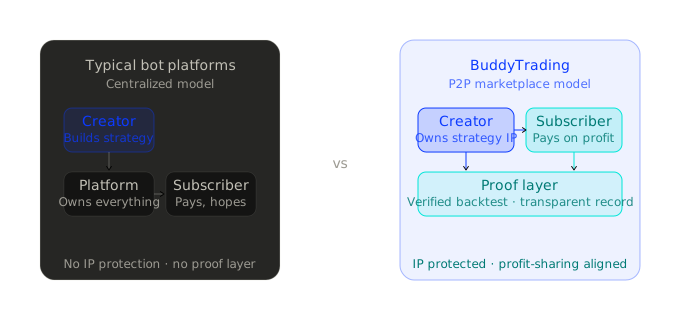
When a quant trader builds a strategy on a typical centralized platform:
The strategy lives inside that platform's infrastructure
There is no independent, verifiable proof that the strategy performed as claimed
The creator earns revenue only as long as they stay on that platform — on the platform's terms
If the platform changes its fee structure, adjusts how strategies are ranked, or decides to build competing in-house products, the creator has limited recourse
This isn't an edge case. It's simply how centralized systems work. The platform controls the data, the distribution, and the revenue flow. The creator is a supplier — necessary, but not protected.
For subscribers, the problem looks different but is equally real. They're buying into performance claims they can't independently verify. The numbers shown on a strategy profile are curated and presented by the same platform that profits from attracting subscribers. There's no neutral proof layer between the claim and the truth.
3. What DeFAI Actually Promises (vs. What It Delivers)
"DeFAI" — decentralized AI for finance — is gaining serious attention in the Web3 space. The core pitch is compelling: AI-driven trading strategies running transparently on-chain, without a central party controlling the funds or the logic.
In theory, this solves the trust problem. If strategy execution is on-chain, anyone can verify it. No black boxes.
The Real Problem with AI Trading Bots: Who Owns the Alpha? | BuddyTrading Blog
In practice, most DeFAI projects today fall into one of two categories:
Yield vaults with "AI-optimized" parameters — where the AI layer is thin and the "decentralized" part mostly means funds sit in a smart contract, not that the strategy logic itself is transparent or auditable.
Fully autonomous on-chain agents — technically ambitious, but with limited human-level discretion baked in, and real open questions about accountability when conditions change or execution fails.
Neither category solves the creator incentive problem. Even if execution becomes trustless, there's still no good answer to the core question: why would a skilled quant trader share their real alpha with a system that doesn't protect their IP or fairly compensate them for results?
Without answering that, even the most sophisticated DeFAI infrastructure will struggle to attract strategies actually worth following.
4. The Creator Incentive Problem Nobody Is Talking About
Here is the core tension in the bot trading market, stated plainly:
The people with the best strategies have the least reason to share them — unless the system is specifically designed to make sharing worth it.
If a quant trader has a genuinely alpha-generating system, the rational move is to run it privately. Sharing it on a marketplace only makes sense if three conditions are met:
Their IP is protected — the strategy logic can't be copied, reverse-engineered, or quietly absorbed by the platform
They get paid based on actual performance — not just access fees that reward presence regardless of results
Their track record is verifiable and portable — something they own, not something that disappears if they leave the platform
Most platforms offer none of these. They offer distribution — more subscriber eyeballs — in exchange for trust that the platform will remain fair indefinitely. That's a weak deal for anyone with real alpha.
This is why so many strategies on typical marketplaces are underwhelming. The best creators don't show up with their best work. They either stay private or share diluted versions that protect their real edge while generating enough signal to attract followers.
5. How BuddyTrading Fixes This
BuddyTrading is designed around a different structural assumption: the strategy creator is the most valuable party in the ecosystem, and the platform's job is to protect and compensate them — not extract from them.
The mechanics that follow from this:
IP protection by design. When a strategy is listed on BuddyTrading's marketplace, subscribers copy trades — they never get access to the underlying code. The strategy logic stays with the creator. The platform facilitates the connection, not the extraction.
A transparent proof layer. Strategies go through backtesting before listing. The performance record — ROI, win rate, drawdown, trade history — is generated by the platform's own infrastructure against real historical data, not self-reported by the creator. Subscribers see the same verified data. No hidden manipulation, no curated highlights.
Profit-sharing that aligns incentives. Creators can earn a percentage of profits generated for subscribers — meaning they get paid only when the strategy actually works. If a subscriber makes money, the creator makes money. If the strategy underperforms, the creator earns nothing. This is fundamentally different from models where creators get paid regardless of results.
Flexibility for different strategy types. Some strategies suit a flat monthly access fee — consistent, lower-risk approaches where subscribers pay for reliability. Others suit pure profit sharing. BuddyTrading offers both models, plus a hybrid, giving creators the ability to structure compensation that fits their strategy's actual risk profile.
The result is a marketplace where skilled creators have a genuine reason to show up with their real best work — because the system is built to reward them when it performs, and protect them regardless.
6. What This Means for You
If you're a strategy creator, the question comes down to structure: would you rather build on a platform that controls your distribution but not your logic — or one that protects your IP and pays you based on real results?
If you're a subscriber, the question is about trust: do you want to follow strategies backed by transparent, independently-generated performance data — or take performance claims at face value from a platform with no financial stake in your outcome?
The bot trading market is evolving fast. DeFAI infrastructure will continue improving on-chain execution and transparency. But the creator incentive problem has to be solved at the marketplace level — in how the product is actually structured — not just at the infrastructure level.
BuddyTrading addresses this with a concrete, working model: IP-protected P2P strategy sharing, verified backtesting, and compensation that's tied to real performance.
That's not a feature list. It's a design philosophy — and it's visible in how every part of the product works.
Ready to explore it yourself?
Browse verified strategies on the BuddyTrading marketplace — or list your own and start earning on your alpha.
👉 Get started on BuddyTrading →
Subscribe to our newsletter and be the first to access exclusive content and expert insights.
Guide
BuddyTrading Features
Make Profit Where Your Money Sits: The Multi-Exchange Automation Advantage
Most crypto investors hold funds across Binance, Bybit, and KuCoin — but only automate one account. Discover how BuddyTrading's multi-exchange automation deploys a single strategy across all your exchanges simultaneously, eliminating idle capital and maximizing returns across your entire portfolio.

 Our Blog
 7 min read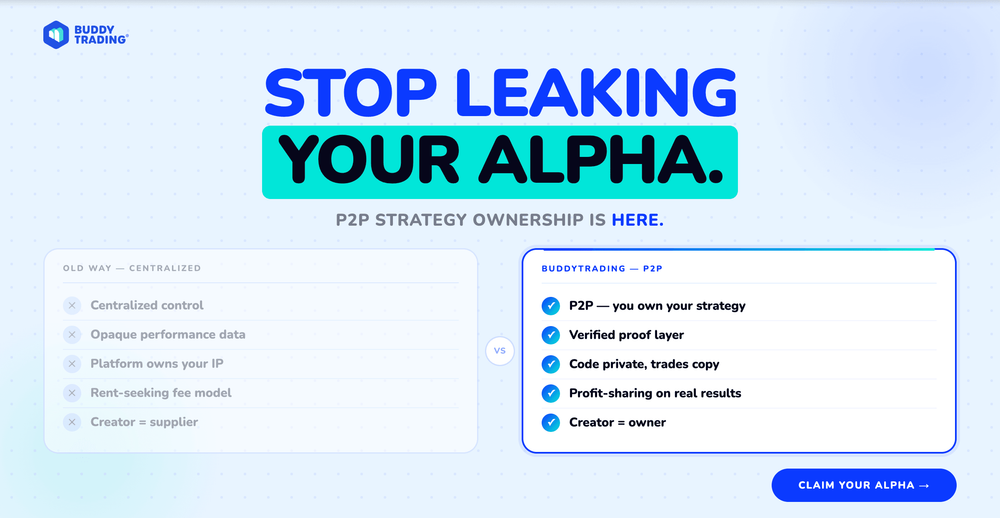

 Mar 3, 2026