In crypto trading, spotting opportunities is only half the battle—keeping your gains is where real success lies. On-chain metrics offer a transparent, real-time view of blockchain activity, helping traders identify adoption trends, investor sentiment, and network health. Risk management strategies like position sizing, stop-losses, and diversification protect your capital from volatility and emotional decision-making. By combining data-driven insights with disciplined trading rules, you can navigate market cycles with confidence, minimize losses, and maximize long-term profitability.
In the fast-paced, high-volatility world of crypto trading, making money is just one part of the game—keeping it is the real challenge. The most successful traders aren’t necessarily the ones who find the next 10x gem or time the market perfectly—they’re the ones who manage risk consistently and systematically.
If you're new to trading or just getting started on platforms like BuddyTrading, understanding risk management is essential to long-term survival and growth. In this post, we’ll break down core risk management principles, tools, and tips tailored for crypto traders and copy traders alike.
What Is Risk Management in Crypto Trading?
Risk management is the process of identifying, assessing, and controlling your exposure to potential losses. In trading, it’s the set of strategies you use to minimize losing trades and protect your capital so that you can stay in the game long enough to profit.
In simple terms:
Risk management helps you lose less when you're wrong and gain more when you're right.
Why Is Risk Management Crucial in Crypto?
Crypto markets are:
Highly volatile: Daily price swings of 5–20% are common.
Open 24/7: No breaks, which means risk never sleeps.
Emotionally driven: FOMO, fear, and greed move markets.
Low regulation: Many coins are speculative and easily manipulated.
Without proper risk management, even a few bad trades can wipe out your portfolio.
Key Risk Management Concepts You Need to Know
1. Position Sizing
Never go “all-in” on a single trade. Smart traders calculate what percentage of their portfolio to risk on each trade.
Rule of thumb: Risk 1–2% of your total capital per trade.
If you have $1,000 in capital, risking 2% means you’d only risk $20 on a single trade. This doesn’t mean you only invest $20—it means you manage your position size (entry, stop-loss) so that your maximum loss is $20.
2. Stop-Loss Orders
A stop-loss is a predefined price level where your trade will automatically close if the market moves against you.
Hard stop-loss: A fixed price set on the exchange.
Mental stop-loss: A price level you manually act on (not recommended for emotional traders).
Why it matters: It protects you from catastrophic loss and enforces discipline.
3. Risk-to-Reward Ratio (R:R)
This measures how much you’re willing to risk versus how much you aim to gain.
Example: If you're risking $50 to make $150, your risk-to-reward ratio is 1:3.
Good traders aim for at least 1:2 or 1:3 ratios. This way, even with a 40–50% win rate, you're profitable over time.
4. Diversification
Don’t put all your capital into one coin or strategy. Diversifying spreads risk across multiple assets or trading approaches.
Risk Management 101: How to Protect Your Capital in Crypto Trading | BuddyTrading Blog
Mix large caps (e.g., BTC, ETH) with mid or small-cap tokens.
Diversify across sectors (L1s, DeFi, AI, etc.)
For copy traders: Follow more than one lead trader to reduce strategy risk.
5. Leverage: Use Cautiously
Leverage can amplify gains and losses. Using 10x leverage on a 10% market dip means you’re liquidated—game over.
Unless you’re a pro, keep leverage low (1x–3x max) and always combine it with tight stop-losses.
Copy Trading: Risk Management for Followers
If you're a copy trader on BuddyTrading, risk management still applies:
Set risk allocation per trader (e.g., only 10–20% of your capital following one lead).
Understand the trader’s style (are they high-risk/high-reward or conservative?)
Monitor their drawdowns: If a lead trader has a 50% drawdown history, prepare for volatility.
Don’t blindly copy: Even good traders lose—diversify who you copy and stay informed.---
Psychological Risk: Your Worst Enemy
Risk isn't just about charts—it’s also about you:
Avoid revenge trading after losses.
Don’t FOMO into trades you didn’t plan.
Stick to your rules, even when it hurts.
Discipline is more important than IQ in trading. Most capital is lost not through bad setups, but through emotional decisions.
Checklist: How to Apply Risk Management Today
Step
Action
1
Set a maximum % risk per trade (1–2%)
2
Always use a stop vueloss (never "hope it recovers")
3
Calculate your risk-to-reward before entering
4
Limit leverage to manageable levels
5
Diversify your trades and portfolios
6
Review your losses and learn from them
7
Don't copy traders blindly—understand their risk profile
Final Thoughts
Risk management might not sound exciting—but it's the bedrock of profitable trading. Whether you're an active lead trader or a passive copy trader, applying even basic risk rules can protect your capital, reduce emotional stress, and help you stay in the game long enough to thrive.
At BuddyTrading, we’re building tools to help both lead and copy traders manage risk transparently—so you can trade smarter, not harder.

 Our Blog
 5 min read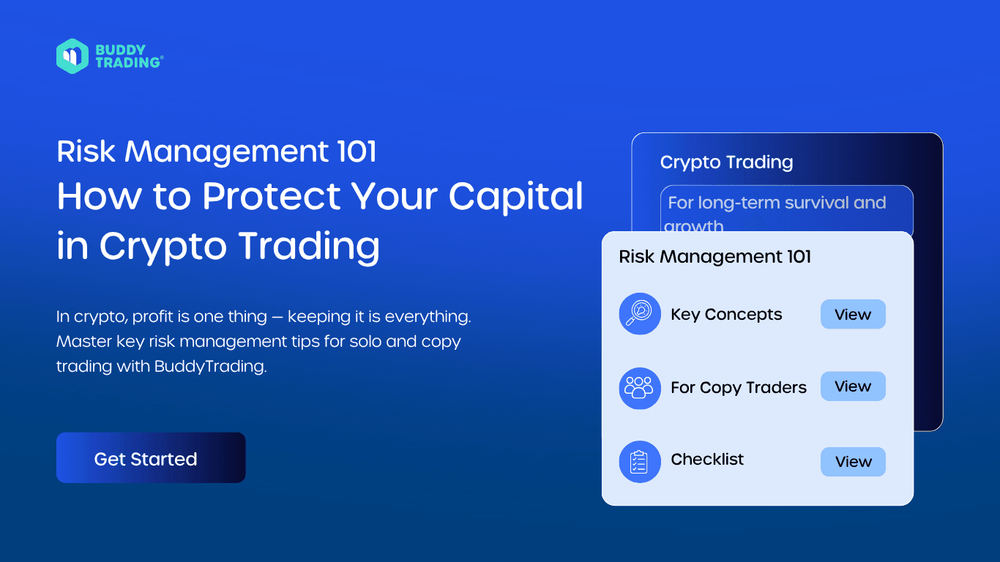

 Dec 18, 2025